Ethiopian Raised Drying Beds: Where Coffee Quality Is Preserved—or Lost
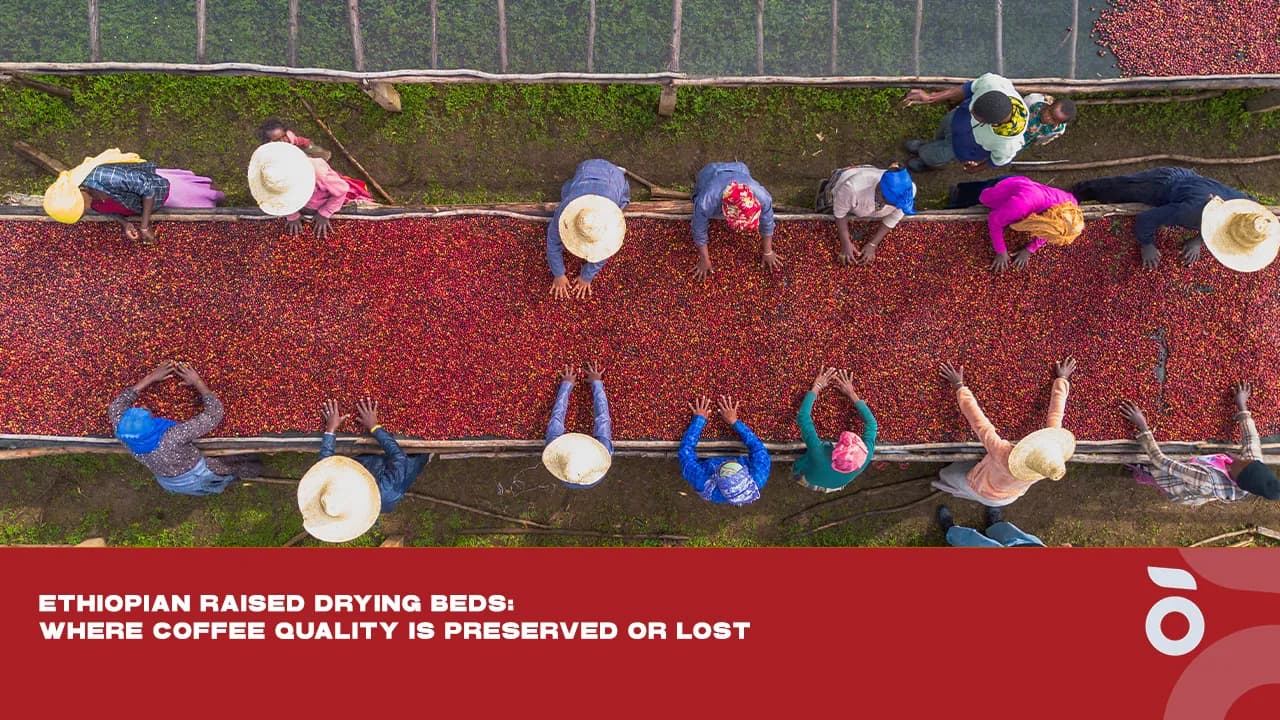
When coffee professionals describe Ethiopian processing, one image appears repeatedly: long wooden tables covered with red cherries or pale parchment, elevated above the ground and surrounded by workers carefully turning the coffee by hand.
These structures are commonly called African raised drying beds. They are strongly associated with Ethiopia and other East African coffee-producing countries. Although they often appear simple, raised beds are among the most important quality-management tools at a farm, washing station or processing site.
A drying bed does not merely hold coffee. It creates an environment in which heat, water, air and time must be controlled.
More Than a Drying Surface
The principal objective of drying is to reduce the moisture inside coffee to a level that supports stable storage. For washed parchment, TechnoServe describes drying from approximately 57% moisture to around 10–12% on a wet basis. The process should be gradual, even and controlled. Coffee that remains unevenly or insufficiently dried may develop fungal growth during storage, while excessively rapid drying can negatively affect quality and longevity.
Raised beds support this process by exposing coffee to moving air from above and beneath the drying surface. This improves convective heat and mass transfer and can help produce more uniform moisture removal than a surface that blocks airflow underneath. Raised beds also separate the coffee from soil, standing water and contaminants found at ground level.
However, these benefits are only potential benefits. A poorly maintained or overloaded raised bed can still produce uneven, moldy or contaminated coffee.
The Ethiopian Bed Structure
More from the blog
Keep exploring stories, guides, and coffee-fueled ideas.
Raised beds do not require sophisticated industrial materials. Their strength is that they can be constructed from materials available near the processing site.
During a coffee experiment conducted in Ethiopia’s Gedeo Zone, TechnoServe established drying beds using eucalyptus poles for framing, bamboo supports, chicken wire and black plastic shade netting. These facilities were designed to reflect common conditions at partner wet mills in Dilla, Wonago and Gedeb.
The structure generally contains four functional elements:
The frame raises the coffee above the soil and supports the load.
The cross-supports prevent the drying surface from collapsing.
The wire or mesh distributes the weight of the coffee.
The netting or mat holds the coffee while permitting air movement and drainage.
The bed should remain level. When its centre sags, coffee collects in the lowest area and creates a thicker layer. The edges may dry quickly while the centre stays wet, producing moisture variation within a single lot. TechnoServe therefore recommends straightening the mesh and reinforcing the frame when necessary.
Raised Beds and Processing Methods
The term “coffee drying” can describe the drying of very different materials.
With natural processing, the complete cherry is dried. The seed remains surrounded by the skin, pulp, mucilage and parchment. This creates a relatively thick biological package from which water must travel before reaching the surrounding air.
With washed processing, most external fruit material has already been removed. The seed is dried inside its parchment layer after pulping, mucilage removal and washing.
With honey or pulped-natural processing, varying amounts of mucilage remain on the parchment.
These materials should not be expected to dry at the same rate. Whole natural cherries generally contain more external fruit material and present different airflow and fermentation challenges from washed parchment. Consequently, bed loading, turning frequency, shading and total drying time must be adapted to the processing method and local conditions.
Layer Thickness: One of the Most Important Controls
A raised bed must not be treated as unlimited storage space.
When the coffee layer becomes too thick, air movement through the mass is reduced. Moisture and heat become trapped between cherries or parchment beans. Coffee near the surface may lose water rapidly, while material in the centre or at the bottom remains wet.
Research in southwestern Ethiopia has shown that drying surface and layer loading significantly influence raw quality, cup quality, drying duration and final grade. Raised beds used with appropriate loading performed better than poorly controlled conventional systems in those experiments.
For washed parchment, TechnoServe recommends a depth of approximately 5 cm during the early skin-drying stage and approximately 5–7 cm during final drying. These figures should not automatically be transferred to every natural coffee. Whole-cherry protocols must account for cherry size, ripeness, elevation, solar intensity, humidity and the desired drying rate.
A professional processor should therefore measure bed loading rather than relying only on appearance. Coffee may be controlled by:
Depth in centimetres
Kilograms per square metre
Total lot weight
Bed surface area
Drying stage
Turning: Creating Uniform Exposure
Coffee does not dry uniformly when it remains in one position.
The upper surface receives more solar radiation and moving air. The underside may remain cooler and wetter. Turning changes the position of the coffee and exposes different surfaces to the atmosphere.
Regular movement also breaks apart clusters, releases trapped humid air and reduces localised heat accumulation. TechnoServe’s washed-parchment guidance recommends turning every two to three hours and at least four times daily, with more frequent attention during the earliest stage. In a controlled Ethiopian experiment, parchment was mixed hourly during the day to promote even drying.
Turning frequency should respond to conditions rather than becoming an inflexible ritual. A processor should consider:
The current moisture level
Bed depth
Sun intensity
Ambient humidity
Wind speed
Coffee temperature
Whether the coffee is natural, honey or washed
The correct question is not only, “How many times was the coffee turned?” It is, “Was it turned often enough to maintain uniform temperature and moisture?”
Temperature and the Myth of Faster Drying
Drying faster is not automatically better.
Strong sunlight can rapidly heat the external layers of a cherry or parchment bean. The outside may appear dry while significant water remains inside. This produces a moisture gradient between the surface and the centre.
TechnoServe advises keeping parchment temperatures below approximately 35°C and using shade during periods of intense overhead sunlight. It also recommends taking several infrared readings across the bed because one reading cannot represent an entire lot.
When temperature rises excessively, processors may:
Increase turning
Spread the coffee more thinly
Use shade netting
Temporarily pile and cover parchment according to the drying protocol
Move vulnerable coffee away from direct peak sunlight
The objective is not to remove water at the maximum possible speed. It is to remove it without damaging the physical and sensory stability of the seed.
Hygiene, Sorting and Traceability
The raised bed also serves as a sorting platform.
During drying, workers can remove immature, overripe, insect-damaged, partially pulped, moldy or otherwise defective material. This is especially effective during the early washed-parchment stage, when defects remain more visible.
The drying area must also be protected from contamination. Smoke, fuel, chemicals, animals, dirty hands, old parchment and coffee from previous batches can compromise quality. Beds should be cleaned between lots, repaired when torn and clearly labelled.
Different grades, farms, processing dates and experimental treatments should remain separated. Combining lots before drying is complete destroys traceability and may mix coffee with different moisture levels.
A simple bed label should include:
Producer or station name
Lot identification
Processing method
Harvest or pulping date
Initial weight
Bed number
Turning record
Weather observations
Moisture readings
Date drying was completed
Knowing When Drying Is Complete
Appearance and hand-feel are useful operational observations, but they should not replace measurement.
Moisture readings should be collected from a representative sample taken from different parts of the bed. Coffee at the edge, centre, top and bottom may not contain the same amount of water.
For washed parchment, a final target around 10–12% moisture is commonly used before storage. TechnoServe’s operational checklist specifies approximately 11–12%. The correct storage decision should also consider measurement consistency, moisture uniformity and—where available—water-activity testing.
Coffee should be allowed to cool before being covered or bagged. Covering warm coffee can trap heat and moisture, creating conditions that reverse part of the drying progress.
Conclusion
Ethiopian raised drying beds represent both tradition and applied post-harvest science.
Their value does not come only from the fact that they are elevated. Their value comes from how they allow processors to manage airflow, heat, water, cleanliness, sorting and traceability.
A raised bed cannot improve an unripe cherry into excellent coffee. It cannot correct poor fermentation or replace accurate measurement. But when it is properly constructed and professionally managed, it can protect the quality developed through genetics, environment, agronomy and selective harvesting.
The final lesson for coffee professionals is simple:
Drying is not the time between processing and storage. Drying is an active quality-control operation.
Comments (0)
No comments yet. Be the first to share your thoughts.



Comments (0)
No comments yet. Be the first to share your thoughts.