Ethiopian Coffee Drying Beds: Bridging Traditional and Modern Methods
Introduction
Ethiopia – the birthplace of Arabica coffee – has a rich history of coffee processing that blends centuries-old traditions with modern innovations. One crucial stage in coffee processing is drying, where harvested coffee cherries or beans are dried to a safe moisture level for storage and export. The way coffee is dried can significantly impact quality, flavor, and consistency. In Ethiopia, coffee drying practices range from traditional sun-drying on ground surfaces to improved raised drying beds (often called African or Ethiopian beds) that elevate the coffee for better results. This overview will delve into both traditional and modern Ethiopian coffee bed construction methods, covering the materials used (from bamboo and wood to mesh nets), design aspects like elevation and airflow, sun exposure and weatherproofing, drainage, and structural stability. We’ll also highlight standards and guidelines (such as those from the Ethiopian Coffee and Tea Authority and the ECX) and note regional adaptations. Finally, we’ll compare these practices with international best practices to see how Ethiopia’s methods stand out and align with global trends. The goal is an engaging yet informative exploration, useful to coffee professionals, curious readers, and even agricultural engineers interested in design details.
Traditional Coffee Drying Methods in Ethiopia
Traditionally, many Ethiopian smallholder farmers dried coffee in situ on the ground or on simple mats under the sun. In the past, freshly picked coffee cherries might be spread on woven straw mats, bamboo mats, or even the bare earth in the farmer’s yard. Over several weeks, the cherries would be turned by hand to dry evenly. This age-old natural drying method (called
More from the blog
Keep exploring stories, guides, and coffee-fueled ideas.
sun-dried
or
natural process
) has been practiced for centuries and is deeply ingrained in Ethiopia’s coffee culture
. It was an ingenious solution in regions with limited water supply – such as parts of Sidama and Harar – allowing farmers to process coffee without needing to ferment and wash it. However, drying coffee on mats at ground level has inherent drawbacks. The coffee can be exposed to dirt and
ground moisture
seeping up, which risks altering flavors or causing mold and contamination
. Inconsistent airflow at ground level can lead to uneven drying, and during unexpected rain, coffee often had to be hurriedly covered with plastic or gathered up, which could induce uncontrolled fermentation.
For a long time, these traditional methods were widespread due to their simplicity and low cost. In fact, surveys in major coffee regions showed that roughly half of Ethiopian producers still practiced ground or mat drying even into the 2000sresearchgate.net. For example, one study in Jimma (western Ethiopia) found about 48% of farmers spread coffee cherries on the ground, while ~49.5% used some form of raised drying bed (often rudimentary constructions using bamboo mats or wire mesh), and only a tiny fraction used permanent patios (cement or brick floors)researchgate.net. The dominance of traditional sun-drying reflects both cultural habit and resource constraints – it requires no special infrastructure beyond mats or tarps.
Yet, these traditional drying practices have been linked to quality inconsistencies. Researchers note that poor post-harvest handling – such as drying coffee in thick layers on the ground and even “heaping” it up during drying – can encourage mold and bacteria growth, leading to off-flavors and lower gradesresearchgate.net. In general, coffee dried directly on soil or without adequate airflow tends to be mustier and more prone to quality defects. In Ethiopia’s export system, such issues contributed to some regions (like Jimma in the past) having a reputation for lower-quality coffee, largely because of these traditional processing shortcomingsresearchgate.net. In short, while the all-natural sun drying approach has a romantic and historic appeal – and can indeed produce wonderfully fruity coffees when done carefully – it has needed improvements to meet the consistency demands of modern specialty coffee markets.
Traditional sun-drying of coffee cherries on mats in a family compound near Konso, Ethiopia. In such setups, cherries dry on bamboo mats or tarps placed on the ground, which exposes them to moisture and pests more than raised bed systemsnationalgeographic.com.
Caption: Traditional ground-level drying in Ethiopia – coffee cherries spread on mats in the sun. This age-old method is simple but can suffer from uneven drying and contamination, as ground moisture and lack of airflow pose challenges.nationalgeographic.comresearchgate.net
The Rise of Raised Drying Beds in Ethiopia
Over the past few decades, Ethiopia’s coffee sector has increasingly turned to raised drying beds to address the limitations of traditional methods. A raised drying bed is essentially a rectangular table-like structure, typically about waist-high, with a mesh or slatted surface on which coffee is spread to dry. These are often called “African beds” – a nod to their prevalent use in East Africa (originating in Ethiopia, by many accounts)baristahustle.com. They have become standard in specialty coffee production because they dramatically improve drying conditions. In Ethiopia, the transition from ground drying to raised beds has been driven by both grassroots wisdom and organized efforts (by cooperatives, the Ethiopian Coffee and Tea Authority, NGOs like TechnoServe, and buyers in the specialty market) to improve quality.
Modern raised beds offer several key advantages: First, by lifting the coffee off the ground (usually 0.5 to 1 meter high), they prevent direct contact with soil and puddles, keeping the beans cleaner and free of earthy taintsnationalgeographic.com. Second, being elevated allows airflow on all sides of the coffee – underneath as well as above – leading to more uniform and faster dryingen.wikipedia.org. Third, the improved airflow and drainage greatly reduce the risk of mold or over-fermentation since moisture doesn’t get trapped. As a bonus, the elevation also keeps the coffee out of reach of many animals and pests and reduces the amount of dust kicked up onto the beans.
It’s no surprise, then, that raised beds are now preferred for high-quality coffee. In fact, most of Ethiopia’s premium washed and natural coffees you’ll find on the market have been dried on raised beds. These beds are so effective that coffee experts deem them the “best (if least used) method of drying coffee” globallyen.wikipedia.org. In Africa, they’ve been common for a long time, and now even Central American and Asian producers are adopting them to emulate the success seen in Ethiopia and Kenyabaristahustle.com. A well-known coffee training resource notes that raised beds are cost-effective and deliver outstanding results, to the point that they’ve largely replaced expensive patio construction in many hilly farming areasbaristahustle.com.
The Ethiopian Commodity Exchange (ECX) and the Coffee and Tea Authority have also reinforced the shift toward raised beds by linking it to quality standards. Top-grade coffees (Grades 1 and 2 in the ECX classification) almost invariably come from properly dried lots, which usually means use of raised beds and careful monitoringresearchgate.netresearchgate.net. There isn’t an explicit law forcing farmers to use raised tables, but through training and market incentives, it’s become the de facto standard for any producer aiming for specialty quality. For instance, the ECX requires that export coffee be dried to about 11–12% moisture for stabilityresearchgate.net – a target much easier to achieve evenly with raised beds than on the ground. As farmers saw the price premiums for well-dried coffee, many have been convinced. There’s a telling example from Sidama: development programs demonstrated raised-bed drying to local farmers who were skeptical at first. Seeing the consistently higher quality and fewer defects, those farmers rapidly adopted the new practice, replacing ground mats with “elevated bamboo beds” despite it challenging age-old habitsnationalgeographic.com. What began with one pioneering farmer spread to neighbors once they “saw the results”, leading to whole communities upgrading their drying methodsnationalgeographic.com.
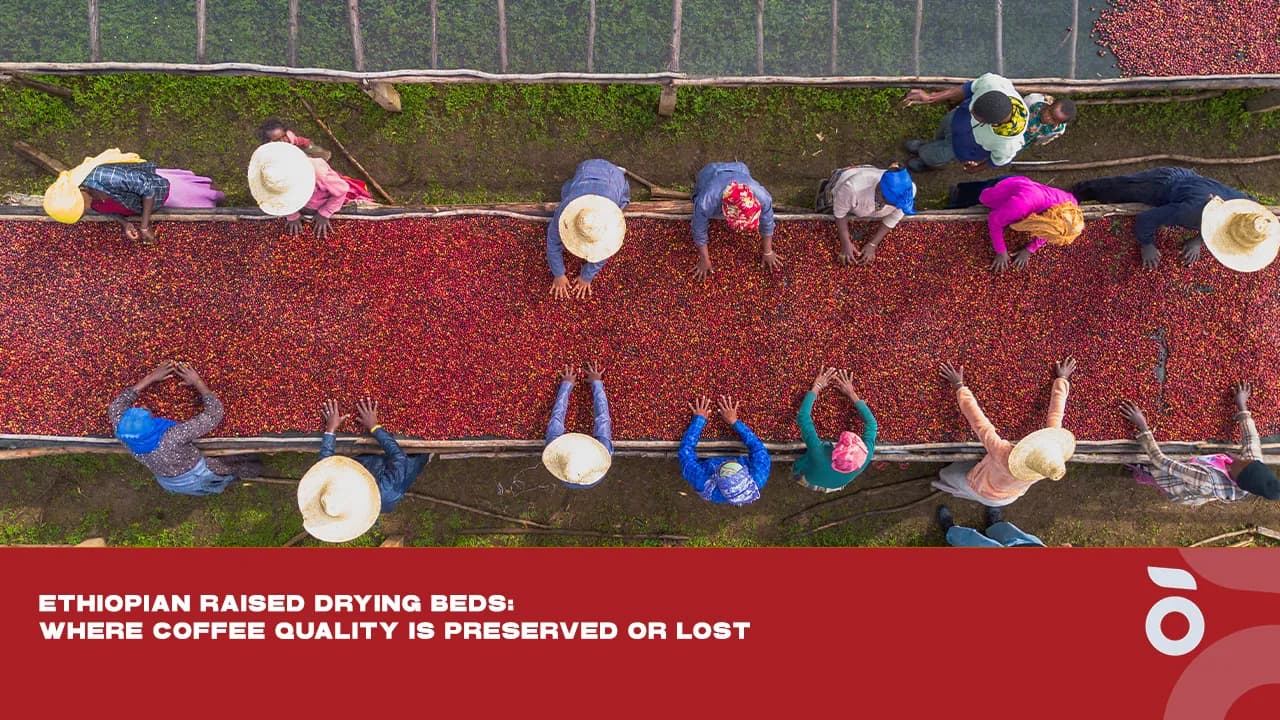
Today, walking into a coffee washing station or processing site in Ethiopia, you’re likely to be greeted by the iconic sight of long rows of raised beds, each covered in a layer of coffee either in its cherry form (for naturals) or parchment form (for washed coffee). Workers move along these beds, tending the crop – turning beans periodically for even drying and picking out defective or overripe cherries. The landscape in coffee towns like Yirgacheffe, Gedeb, Kochere, or Guji is often dotted with these tables, sometimes stretching as far as the eye can see on hillsides. A single large washing station can have hundreds of such beds, each one perhaps 5–15 meters long and 1–1.5 meters wide, holding coffee from dozens of farmerscambercoffee.com. In peak harvest season, these raised platforms are vibrant with the reds and yellows of ripe coffee cherries or the pale beige of drying parchment.
It’s worth noting that despite the progress, not every farmer in Ethiopia has equal access to the materials or space for raised beds. In some more remote or resource-poor areas, traditional drying persists – but even there, many farmers have improvised by putting mats on top of stones or logs to get some of the benefits of elevation. The trend, however, is clear: raised drying beds have moved from “experimental” to mainstream best practice across Ethiopia’s coffee regions, thanks to the tangible improvements in cup quality and market value they provideresearchgate.net.
Materials and Construction of Raised Drying Beds
Ethiopian raised drying beds are ingeniously simple in construction, often made with locally available materials. The typical bed is a rectangular wooden frame with legs, topped with a mesh or lattice that actually holds the coffee. Let’s break down the common materials used:
Wooden Posts and Frame: The support structure of the bed is usually made of wood. In Ethiopia, eucalyptus poles are commonly used for the legs and frame, as eucalyptus is widely grown and provides sturdy, straight poles. Other local timbers or even bamboo can serve as posts. A standard design might use 2×4 lumber for the vertical posts (legs) and thinner lumber (2×2 or similar) for the horizontal frame that forms the rectangleperfectdailygrind.com. Bamboo is also extremely popular: many traditional raised beds use thick bamboo canes as the frame rails and legs, given bamboo’s strength and availability in regions like Sidama and Jimma. In fact, some Ethiopian sites rely almost entirely on split bamboo for the entire bed structure – bamboo slats are lashed together to form a flat bed surface and side edgescambercoffee.comcoffeeshrub.com. Bamboo has the advantage of being lightweight, inexpensive, and slightly flexible (which helps it resist cracking under load).
Mesh or Bed Surface: The surface on which coffee is spread is crucial. It needs to allow airflow yet not let the coffee fall through. Different materials are used here:
Woven Mesh (Netting): Many modern operations use a food-safe polypropylene mesh or shade cloth stretched across the frameperfectdailygrind.combaristahustle.com. This mesh is like a durable fabric with fine holes – it’s gentle on the coffee, breathable, and doesn’t react with the beans. Often it’s black or dark-colored (as noted in some guides: “black plastic netting” specifically made for drying beds)perfectdailygrind.com. This kind of netting is ideal because it’s odorless, UV-resistant, and easy to remove and clean.
Chicken Wire or Metal Mesh: Another common option is galvanized wire mesh (chicken wire). A layer of chicken wire can be nailed or stapled onto the frame to create a metal grate that coffee rests onperfectdailygrind.com. Chicken wire allows superb airflow. However, it has some downsides: the metal can heat up in the sun (potentially affecting the coffee on very hot days) and, if not tightly secured, it may sag under weight. Indeed, farmers have observed that wire mesh without proper support tends to sag and create uneven pockets of coffee, which dry at different ratescoffeeshrub.com. For this reason, some designs include additional support wires strung beneath the chicken wire. For example, one construction method runs parallel metal wires across the frame every 30 cm or so to support the chicken wire from belowperfectdailygrind.com.
Bamboo Mats or Slats: In traditional/cooperative settings, you still see bamboo lattices used as the drying surface. Split bamboo can be woven or laid out in a grid. CoffeeSpread on these bamboo mats benefits from bamboo’s neutral odor and porous nature. A great example is the Buku site in Guji, where the beds are built with split bamboo reeds laid flat; a layer of burlap or muslin cloth is then placed on top to allow air through while preventing smaller beans from falling through gapscoffeeshrub.com. This approach yields a flat, sturdy surface and avoids the sagging issue of wire. However, bamboo, being organic, will wear out faster and need periodic replacement as it warps or rots.
Fasteners and Treatment: Nails, screws, and natural fiber ropes or twine are all used to assemble and reinforce the bed. Many Ethiopian farmers simply tie bamboo pieces together with twine for a low-cost assembly. More modern builds might use nails and hammer, or even screws, to secure wood piecesperfectdailygrind.com. To extend lifespan, wooden parts are often treated. A traditional trick is to soak the cut ends of wooden posts in diesel or oil for a day or two, which helps repel insects and rot when those ends are in the groundperfectdailygrind.com. Wood posts might also be coated with a sealant or used engine oil as a preservative in some casesperfectdailygrind.com. This is important because Ethiopian beds face sun, rain, and insect exposure for years on end. Treated wood can significantly increase the longevity of a drying bed.
Side Rails and Edging: A raised bed usually has side walls or rails about 5–15 cm high along the edges of the surface. These can be thin wooden slats (e.g., 1×4 lumber) nailed along the perimeterperfectdailygrind.com, or simply the upturned edge of a bamboo mat. The purpose of these rails is to keep coffee from rolling off the bedperfectdailygrind.com – remember that workers will be raking and turning the beans, and without a small barrier, cherries could tumble to the ground. The side rails also add a bit of structural rigidity to the frame.
Leg supports: Typically, the legs of the bed (the vertical posts) are either driven into the ground or attached to stakes in the soil. On some farms, builders dig a small posthole for each leg and pack soil or stones around it. In other cases, especially where portability is needed, the beds simply rest on the ground without burying the legs – the weight and bracing keep them stable. Large communal beds might have central legs or bracing beams in the middle as well, to prevent sag over long spans.
A standard Ethiopian raised bed might measure around 1.2 meters wide (about 4 feet) and anywhere from 5 to 15 meters long, depending on space and volume needsperfectdailygrind.comperfectdailygrind.com. The width is often kept around 1.2–1.5 m so that a worker can reach to the center of the bed from either side for easy turning and sorting of beans. If the bed is too wide, it becomes hard to manage the coffee in the middle. Length can vary; very long beds will have additional legs at intervals (every 1–1.5 m) to support the spanperfectdailygrind.com. In one example, posts were spaced 1.22 m apart along a 12 m long bed – resulting in about 10 support legs including the endsperfectdailygrind.com.
To summarize the build: Farmers or workers erect a series of wooden or bamboo posts, ensure the tops are level (using a string line or level) at the desired height, nail or lash cross-bars to form the rectangular frame, then stretch and fasten the mesh or lattice on top. Side rails or edges are added, and the bed is ready to use. Simplicity is key – these beds are often built in a day or two with just hand tools like saws, hammers, and maybe a post-hole digger. The materials like mesh and wire come in rolls, so they are cut to size on-siteperfectdailygrind.com.
It’s interesting to note that not all raised beds are stationary. In some Ethiopian processing sites, they have movable trays or stackable beds in greenhouses, but the vast majority are fixed tables out in the open or under simple sheds. The cost of building raised beds is regarded as an investment with quick returns: a smallholder who spends a bit on mesh and lumber can see their coffee fetch a higher price due to better qualityperfectdailygrind.com. And since these beds can be used for many harvest seasons (with minor repairs), the annualized cost is quite low relative to the value gained.
Elevation Design: Height and Structural Layout
One of the defining features of these drying beds is their elevation off the ground. Most Ethiopian drying beds are raised to about 0.8 to 1 meter above ground level – roughly waist height for an adultperfectdailygrind.com. This height is intentional and optimized for several reasons:
Ergonomics: Waist-high beds allow workers to comfortably reach and stir the coffee without excessive bending. Given that laborers might turn or rake the coffee dozens of times a day, a convenient height improves efficiency and reduces fatigue. If the bed were too low, workers would be stooping; too high, and they couldn’t easily reach the center. Around 0.9–1.0 m tends to be a sweet spot. In fact, when constructing, builders often adjust the post height so that the bed surface is “just above waist level” using the height of the first and last posts as a guide and leveling the rest to thatperfectdailygrind.com.
Airflow and Heat: Height also contributes to temperature and airflow. At 1 m high, the coffee is sufficiently distant from the cooler, damp ground surface. Air can flow freely underneath, carrying away moisture. This creates a bit of a convection effect, especially on warm days – cool air enters from the sides below, picks up moisture from the drying coffee, and exits upward. The raised position also means the coffee benefits from breezes more than if it were at ground level behind bushes or slopes. In Ethiopia’s highlands, afternoons often have gentle breezes that help drying; raised beds capture that airflow.
Protection: While 1 meter isn’t high, it does offer some protection. It reduces the chances of chickens scratching at the coffee or dogs and goats walking over it (common village nuisances in ground drying!). It also means that in a sudden heavy rain, splashing mud from the ground won’t reach the coffee easily – the beds act like tables, and rainwater mostly hits the ground below or passes through the mesh, rather than pooling around the beans.
In terms of layout, the beds are usually arranged in rows with walking space between them. A common layout might have about 0.5 to 1 meter of gap between beds so that workers can move around with tools or carry coffee to and from the beds. In cooperative processing stations, you’ll see a very neat grid or parallel arrangement on flat terraces, whereas on small farms, beds might be wherever space allows, sometimes terraced along hillsides. Raised beds actually shine on uneven terrain: unlike patios that require a flat expanse, beds can be individually leveled by cutting the leg lengths accordingly or sinking legs on the uphill side deeper into the groundperfectdailygrind.com. Ethiopia’s coffee regions are often hilly (farms at 1800–2200 masl are on slopes), so raised beds have been a boon – farmers can dry coffee on steep hills by just ensuring each bed’s surface is horizontal (even if one end’s legs are shorter than the other due to the slope)perfectdailygrind.com.
Structurally, for longer beds, cross-bracing is important. Some beds have diagonal braces or tie-bars between legs to prevent wobbling. If we peek under a well-built bed, we might see that halfway up the legs, a piece of wood connects opposite legs forming an “X” or a horizontal bar, giving extra rigidity so the bed doesn’t sway or rack. Given the lightweight nature of bamboo or thin lumber, these braces keep the bed stable in winds and under loads.
In summary, the elevation of Ethiopian drying beds is a carefully considered design element. Around one meter height offers an ideal balance of airflow, ease of work, and protection. It essentially creates a drying loft for the coffee – away from the damp earth, yet close enough for humans to manage the product. Engineers might appreciate that this height also tends to align roughly with the height of convective boundary layer near ground on a sunny day – meaning the coffee sits in a band of warm air during daylight, which aids evaporation. Though not sure ancient farmers thought of it in those terms, through trial and error they arrived at a very practical height that modern studies would likely agree with!
Airflow and Ventilation Considerations
Proper airflow is critical in coffee drying, and the raised bed design excels at providing it. Ventilation is the magic that ensures coffee beans dry evenly and safely. Here’s how Ethiopian drying beds address airflow:
Bottom-Up Airflow: Unlike coffee spread on a solid floor or tarp, coffee on raised mesh beds gets air from below. As the sun heats the coffee from above, moisture is drawn out of the beans and cherries. That moisture can escape downward through the mesh. Air moving under the bed carries away this humidity. In essence, each bed acts like a drying rack with natural convection – cool dry air in, warm moist air out. This significantly speeds up drying and promotes uniformity, as all sides of the bean are exposed to airen.wikipedia.org. Scientific comparisons have shown that coffee dried on raised beds generally reaches target moisture in fewer days than coffee dried on static ground surfaces, all else being equal.
Breathable Surface Material: The choice of bed surface (mesh, wire, bamboo slats) is all about airflow. Materials like plastic sheets or tarpaulins are not used as the direct drying surface because they would trap moisture and block ventilationbaristahustle.com. Instead, Ethiopians use breathable media – whether it’s a porous cloth, woven grass mat, or wire netting – to ensure continuous air circulation around the beans. One coffee processing guide emphasizes that the drying surface must be breathable and odorless, cautioning that plastic is unsuitable except as a temporary cover, because “air should be able to circulate around the coffee laid on the beds.”baristahustle.com.
Thin Layer Spreading: Airflow is only effective if the coffee isn’t piled too deep. On Ethiopian beds, workers usually spread the coffee in a relatively thin layer – often just a few centimeters thick (one bean or cherry layer deep, or a bit more)researchgate.netscribd.com. This maximizes exposure to air. Research in Ethiopia has quantified this: drying cherries at a density of about 20–30 kg per square meter (a thin layer) on raised beds produced the best quality and prevented mold, whereas thicker layers dried slower and with more fermentationresearchgate.net. In practice, farmers aim for something like 2–5 cm of coffee depth on the bed. Workers will continuously rake and redistribute the cherries to avoid clumping and ensure every cherry “sees” some airflow.
Turning and Stirring: Even with good airflow, manual intervention is key. Ethiopian coffee handlers are diligent about turning the coffee on the beds regularly – often multiple times a day. In the midday sun, cherries might be turned hourly. This prevents any single side of a bean from overheating or any pocket from staying too wet. It effectively aerates the layer. Observers note that women (and men) singing as they work will use small rakes or just their hands to shuffle the beans around, ensuring ventilation reaches every partnationalgeographic.com. This labor-intensive practice is one reason Ethiopian naturals can achieve such high quality; the airflow is coupled with constant movement, preventing mold on the underside of cherries.
Bed Spacing and Orientation: While not always precisely engineered, many Ethiopian sites naturally space beds with wind patterns in mind. Placing beds with the long side facing the prevailing breeze can allow wind to flow down the length of the bed. Additionally, leaving space between rows of beds (instead of one continuous block) allows air to channel through. In the highlands, where afternoons bring upslope or downslope breezes, aligning beds along slopes can also help catch those air currents. Some larger operations build raised beds inside ventilated marquees or solar dryers – essentially tent-like structures with open sides – to maximize warm airflow and also guard against rain. In those cases, fans or just roof vents may be used to enhance airflow further, but the principle remains natural convection.
The result of all these measures is a uniform drying process. Coffee on raised beds tends to dry more evenly (less case-hardening, where the outside dries too fast and traps moisture inside) and with fewer hotspots of humidity. This uniformity directly translates to quality: beans dry to the target ~11% moisture consistently, which preserves flavor and prevents mold development. Cup-wise, well-ventilated drying preserves the desirable acidity and clarity of flavor, whereas poorly ventilated coffee can develop fermenty or off flavors.
As a testament to this, the Specialty Coffee Association (SCA) and other coffee bodies often cite raised beds as a best practice for quality because of the superior airflow. And indeed, the majority of fine coffee in Ethiopia is dried on raised tables with ample ventilation, whereas lower-grade lots, which might have been partially ground-dried, show more flavor defects. Simply put, airflow is the lifeblood of proper coffee drying, and Ethiopia’s raised beds provide a natural and effective way to keep the air moving. As one source succinctly stated: “The best (if least used) method of drying coffee is using drying tables... air passes on all sides of the coffee, drying is more uniform, and fermentation is less likely.”en.wikipedia.org – a principle Ethiopian farmers have leveraged to great effect.
Sun Exposure and Weather Protection
Drying coffee is a bit of a Goldilocks scenario: you want plenty of sun and warmth, but not so much harsh exposure that you “cook” the coffee or dry it too fast. Likewise, you need to protect the coffee from rain and dew. Ethiopian drying beds are managed in ways to balance these needs:
Maximizing Sunlight: Ethiopia’s coffee regions lie near the Equator, so day length is fairly consistent and sunlight is strong. Raised beds are usually located in open areas where they receive full sun for most of the day. Often, beds are oriented east-west so that both sides of the bed get equal sun exposure over the day (this prevents one side of a cherry from consistently being in shade). The elevation of the bed means even the lower parts of the terrain can catch sun without being in the shadow of nearby beds or foliage. Some processing sites strategically clear surrounding bushes or tree branches that might cast shade on the beds during peak hours. The aim is to have at least a good 8–10 hours of sunlight on the coffee per day during drying, as weather permits.
Preventing Over-Exposure: Too much sun can be detrimental, especially in the first days of drying. If freshly harvested cherries are exposed to extremely intense midday sun, they can overheat or dry too rapidly on the outside, locking in moisture inside (case hardening). Ethiopian farmers have traditional knowledge to mitigate this. In the hottest part of the day, they may cover the beds lightly or increase turning frequency to avoid hot spots. Some sites use shade nets or mesh canopies to diffuse the sun during the initial drying period. For instance, a common practice is to dry coffee under partial shade for the first 2–3 days (often called “soft drying”), then finish in full sun. This is reflected in some exporters’ notes – e.g., washed coffees might be dried under shade for a few hours each day initially, then fully in sun, to ensure gentler moisture removalmelbournecoffeemerchants.com.aumelbournecoffeemerchants.com.au. Natural processed (whole cherry) coffees, which take longer, sometimes get moved around: starting on sunnier beds, then consolidated onto shadier beds later, to slow down at the end of drying for quality.
Rain and Moisture Protection: One reality in Ethiopia is that the coffee harvest often overlaps with some rains or at least very damp nights (especially in highland areas where nightly dew is heavy). Thus, protecting drying coffee from rain and dew is critical. Raised beds help because even if it rains, water mostly drips through or off the sides, rather than pooling around the coffee as it would on a tarp. However, if rain falls directly on the coffee, that’s obviously a setback (re-wetting can trigger undesirable fermentation or mold). To handle this, Ethiopian processors employ several strategies:
Tarps and Covers: Every professional washing station keeps large plastic tarpaulins or sheets at hand. If dark clouds loom in the afternoon, workers will quickly cover the beds with tarpsperfectdailygrind.com. Often these tarps are rolled up and kept at the end of each bed for quick deployment. At sunset, many also cover the coffee overnight to prevent dew from settling on it (and uncover in the morning once the sun is up). The tarps are never left under the coffee – they’re only draped over the bed or used to wrap up the coffee, because as mentioned, you don’t want coffee sitting on plastic without airflowbaristahustle.com.
Removable Mesh “Lids”: Some innovative setups use mesh panels that act like lids. These can be flipped on top of the bed during rain – they let some air through but break the force of raindrops. More commonly though, plastic sheeting is used for full waterproofing in rain.
Raised Canopy Structures: In higher-rainfall regions (like parts of southwestern Ethiopia), you’ll find raised beds built under simple shelters
Controlled Slow Drying: One might think the faster the drying the better – to avoid fermentation. But actually, controlled slow drying is often preferred for quality. Ethiopian specialty coffee producers aim for roughly 10 to 15 days of drying time for washed parchment, and 15 to 21 days for natural cherries, depending on weathercambercoffee.comperfectdailygrind.com. This relatively slow pace (compared to mechanical dryers that could do it in 2 days) allows flavor precursors to develop and avoids “baking” the coffee. Raised beds aid this by making drying consistent; if it’s too hot, workers can pile the coffee a bit thicker or use shade nets to slow it down; if it’s too humid, they can spread it thinner on more beds to speed it up. In one high-altitude Guji site, because of limited direct sun, naturals took up to three weeks to fully dry, but this “slow, even development” was credited with producing especially refined sweetness in the cupcambercoffee.com. The key is that even while slowing down, they prevent mold by those protective measures and constant movement of beans.
To sum up, sun exposure is maximized but managed. Ethiopian drying beds harness the powerful sun to remove moisture, but farmers have learned to temper that power with shading and covering techniques. They literally “chase the sun” when needed (moving beds or starting new batches when sunny days come) and “hide from the rain” when necessary (covering beds during showers). This dance with the elements is a critical part of the drying stage. It’s often said that coffee dries in the sun but lives in the shade – meaning you need both. Ethiopian methods exemplify that: lots of sun, moderated by careful human intervention to ensure that neither thunderstorms nor scorching noon heat ruin the coffee. The end result is beans that are dried to the perfect level, with bright Ethiopian sunlight locked into their flavors, and none of the damage that uncontrolled elements could inflict.
Drainage and Cleanliness
Drying coffee involves dealing not just with the beans themselves but also with by-products like the mucilage (fruit pulp) in natural processing, as well as dust, and waste. Good drying bed design thus also accounts for drainage and cleanliness:
Drainage of Liquids: In natural processing (drying whole cherries), especially in the first couple of days, some juice can seep or drip from the cherries as they start to shrivel. Raised beds handle this well: any liquid drips through the mesh to the ground. On a patio, that sticky juice would remain around the beans and potentially cause localized fermentation or stickiness. On a raised bed, it’s gone – gravity takes it away. This keeps the coffee cleaner and less prone to harboring mold on that sugar-rich residue. The ground beneath Ethiopian drying beds is often stained with these natural sugars, but the coffee on the bed stays high and dry. Farmers sometimes lay banana leaves or plastic under beds not to catch the liquid for any reuse (it’s not useful), but to prevent weeds from growing or mud from splashing up. However, usually the drip just soaks into the soil.
Rainwater Drainage: As mentioned, if rain hits a bed before it can be covered, the water mostly percolates through or runs off the sides of the mesh. Beds with a slight camber or tension on the mesh will let water drain off quickly. Contrast this with coffee dried on the ground: even a small rain can create puddles that the coffee sits in, or mud that cakes onto beans. Raised beds inherently avoid that scenario – water doesn’t pool on mesh. That said, after any rain, workers will come and gently shake or turn the coffee to remove excess surface water and then let the airflow do its job to dry it back out. The quick drainage significantly reduces the risk of prolonged wetness.
Cleanliness and Hygiene: A big advantage of raised beds is ease of cleaning. After a batch of coffee is finished drying and removed, the bed can be swept, and any remaining parchment dust, cherry skins, or debris can be cleared off. Many washing stations will actually brush off or even rinse the drying mesh between uses. Since the beds are human-height, it’s easy to inspect them for any mold or dirt and address it. Some co-ops sun-bleach the empty beds or spray them with a mild chlorine solution to sanitize, especially if a mold outbreak occurred. Try doing that with a dirt patch or huge patio – much harder! The cleanliness of the bed contributes to clean cup flavors. If you’re drying on a mat that might have absorbed odors or on soil that had fungus, those could transmit to the coffee. A well-maintained mesh or bamboo surface largely avoids that, as it doesn’t harbor old residue if cleaned.
Avoiding Contaminants: Ethiopian producers know to avoid drying coffee on surfaces with strong smells or contaminants. Raised beds keep coffee off the ground, away from livestock areas, away from where vehicles drive, etc. There’s also a practice of not drying coffee near where water is standing (because stagnant water could promote bacteria). The raised beds allow them to choose airy, well-drained spots for drying, often on the tops of slopes or on specially prepared terraces.
Ground Maintenance: The area under and around drying beds is often kept tidy. Some stations put down gravel or crushed stone under the beds to prevent mud. Others keep the ground well weeded and sometimes sprinkle lime or ash to keep insects and rot away. In traditional home-drying, farmers might even burn a little incense or use smoke near the beds in the evenings – partly cultural, partly perhaps to keep bugs at bay (one could liken it to “smudging” a crop, although note that actual smoke can infuse coffee with smokiness, so it’s not common in professional settings). The key is that the environment around the bed is managed so that drainage is good and hygiene is maintained.
Trash and Foreign Objects: With raised beds, it’s easier to spot foreign objects (like a stray nail, a bottle cap, leaves) because you can see both on top and below the bed. Workers will routinely pick out twigs, leaves, and any debris from the coffee as it dries. The side rails help keep out blowing trash. Compare this to coffee drying on the roadside (as sometimes seen in other countries): raised beds clearly offer a more controlled, clean environment.
To illustrate how effective these measures are, consider that Ethiopian natural coffees (dried in fruit) from good mills often have remarkably clean, vibrant flavors without ferment or earthiness – a feat that is only possible when the drying was done on clean surfaces with good drainage. In the bad old days, some natural Harar coffees had a rotting-fruit or earthy taste from being dried on the ground; nowadays, a well-dried natural Yirgacheffe can taste like ripe blueberries and chocolate, with no mustiness – thanks to raised bed drying that kept it clean and properly aerated.
In summary, drainage – of both water and coffee juices – and cleanliness are integral benefits of the raised bed design. By keeping the coffee off the ground, allowing liquids to escape, and enabling easy cleaning, the beds ensure that nothing unwanted ends up in your cup. As one National Geographic piece noted, the adoption of raised bamboo beds in place of ground mats was partly to ensure “the coffee is kept off the ground and away from moisture”, thereby preserving the distinctive flavors and preventing contaminationnationalgeographic.com. Clean, dry coffee is the foundation of quality, and Ethiopia’s drying beds have become a model for achieving just that.
Ensuring Structural Stability and Longevity
Ethiopian drying beds, while simple, must be strong and stable enough to support the heavy loads of coffee and withstand outdoor conditions. A fully loaded bed can have several hundred kilograms of wet coffee (coffee is often spread at ~20 kg/m²; a 10 m² bed might hold ~200 kg of coffee initially)researchgate.net. Without a stable structure, the bed could sag, tip, or even collapse, which would be disastrous mid-harvest. Here are the key considerations and practices for structural stability:
Strong Joinery and Support: The bed’s wooden or bamboo frame is only as good as its joints. Builders use nails or strong ties at all intersections of posts and beamsperfectdailygrind.comperfectdailygrind.com. A common approach is to nail the frame (the rectangle) securely onto the tops of the posts. In some cases, especially with bamboo, additional lashing with rope or wire is done at joints for extra support. For long beds, additional support posts are added at the midpoint or third-points of the span, so the weight is not borne only by the four corner legsperfectdailygrind.com. This prevents sagging in the middle over time.
Wire Tensioning: As noted earlier, when chicken wire is used, growers will often string tension wires across the frame to keep the bed from bowingperfectdailygrind.com. They hammer in U-nails (fence staples) to hold these support wires taut. This measure keeps the drying surface flat even when loaded. It’s effectively like creating a series of mini-beams out of wire to help carry the weight. By distributing the weight, the bed avoids developing a hammock-like sag in the middle.
Ground Anchoring: Many beds have legs buried ~30–50 cm into the groundperfectdailygrind.com. By anchoring the posts, the bed can resist winds or accidental knocks. In rocky areas, legs might be tied to stakes or have rocks piled around their base. Some farmers drive an angled stake and then tie the bed leg to that stake with rope for reinforcement. At washing stations, you might see that end posts are braced against each other or against a fixed point like a tree or a larger pole structure.
Preventing Rot and Insect Damage: A collapsing bed is often due to a leg rotting at the base or being eaten by termites. To combat this, as mentioned, wood is treated (diesel soak, etc.)perfectdailygrind.com. Also, many will char the end of a bamboo pole (lightly burn it) as a way to harden it against rot before sticking it in the ground. These traditional techniques greatly improve longevity. It’s not uncommon for a well-built bed to last 3–5 years or more with minor repairs. Periodic maintenance is important: each off-season, workers will check for any loose nails, replace any broken bamboo slats, and perhaps give wooden parts a new coat of protective oil or sealer.
Load Management: A subtle aspect of stability is how the coffee is loaded. Farmers know not to heap all the coffee in one corner of the bed – it should be evenly spread. Uneven loading could tip a bed or strain one side. The side rails also serve as a visual guide – coffee usually is kept below the top of the rail, which indirectly limits how much can be piled on (preventing overloading). If an exceptionally large harvest comes in, instead of overloading existing beds, new temporary beds are often erected or coffee is dried in multiple batches, to avoid strain.
Resistance to Wind: Ethiopia’s dry season can bring occasional gusty winds (for example, afternoons can be breezy). An empty bed offers little resistance, but a bed full of lightweight coffee parchment could act like a sail if a tarp is on it or if wind blows strongly across a whole field of beds. To prevent any mishaps, many larger operations situate beds in areas with natural windbreaks (like surrounded by hedges or eucalyptus rows). In very windy locales, some will put a cross-brace or diagonal support on the legs facing the prevailing wind. Think of it like how fences have diagonal braces at corners – similarly a drying bed might have a diagonal stick from one leg to another to keep it rigid. These braces help the bed not to rack (twist) in high wind.
Multiple Tier Beds: While most Ethiopian beds are single-layer, some experiments with stacked beds (two tiers) exist to save space. In such cases, ensuring stability is even more crucial (the structure is essentially a small scaffold). Typically, stronger lumber and cross-bracing are used for multi-tier racks, or metal supports might be introduced. However, stacked systems are rare in Ethiopia – the abundant land in rural areas means horizontal beds suffice and are easier to work with. Where stacking is done (like in a drying house), engineers have definitely had to apply more robust construction (akin to bunk beds with diagonal braces).
Inspection and Training: Coffee cooperatives often train their members on building and maintaining beds. For instance, they emphasize not using partially rotten wood or termite-infested bamboo for legs, no matter how cheap it is – because a collapse would ruin quality and cause loss. They also instruct on keeping heavy tools or activities away from beds (you wouldn’t thresh grain right next to a loaded coffee bed, for example, to avoid knocking it). During the season, site managers keep an eye on bed conditions. If a bed looks unstable or sags, they’ll stop using it until fixed.
The combination of these practices means failures are rare. When done right, an Ethiopian drying bed can hold hundreds of kilos of coffee through weeks of drying, under sun and rain, without issue. A well-structured bed provides peace of mind so that the focus can be on the coffee itself, not on whether the platform will hold up.
One tangible standard: Some guidelines (from TechnoServe or agronomy manuals) suggest an ideal bed can support at least 15–20 cm depth of wet coffee cherries without deforming – even though they won’t actually pile it that deep for drying, that’s a test of sturdiness. By using extra posts and taut wire supports, this kind of strength is achievable with modest materialsperfectdailygrind.com. The fact that many Ethiopian washing stations reuse the same drying tables year after year – with minimal inputs – speaks to how appropriately durable the traditional designs are.
In conclusion, structural stability in coffee drying beds is achieved by thoughtful construction (solid joints, ample supports), protective measures (treating wood, anchoring legs), and mindful operation (balanced loading, maintenance). These tables might look rustic to an outsider, but there is a lot of practical engineering wisdom in their design. An agricultural engineer would appreciate the redundancy (multiple supports for critical components), the use of triangle bracing (diagonals providing rigidity), and the material treatment for longevity – all done with locally available resources, often without any formal plans drawn on paper, but rather passed down through demonstration and iteration. It’s a great example of vernacular engineering ensuring that form meets function.
Quality Standards and Ethiopian Guidelines
Ethiopia’s push toward better drying practices has been reinforced by quality standards and guidelines from national institutions and the market. While there isn’t a specific published “drying bed construction code” in Ethiopian law, several standards and authorities influence how coffee is dried and thus indirectly how beds are managed:
Ethiopian Commodity Exchange (ECX) Standards: The ECX is responsible for grading and auctioning the majority of Ethiopian coffee. They have clear criteria for moisture content, defect count, and cup quality for each grade. For instance, as noted earlier, the ECX (circa 2009) stipulates that coffee should be around 11.5% moisture for grading, and it defines grades (1 through 9) largely by cup quality and defect toleranceresearchgate.net. While ECX doesn’t explicitly mandate “thou shalt dry on raised beds,” it’s implicitly required if you aim for Grade 1 or 2, because it’s nearly impossible to achieve the low defect count and high cup score of those grades with ground drying. ECX quality auditors at processing sites often encourage best practices. Additionally, the sampling standards (like ESBN 8.001 mentioned in one documentresearchgate.net) ensure that moisture is measured accurately – pushing processors to hit the right drying targets.
Ethiopian Coffee and Tea Authority (ECTA) Guidelines: The Coffee and Tea Authority (formerly Coffee & Tea Development and Marketing Authority) provides extension services and training on coffee processing. They advocate raised bed drying in their training materials. In fact, an Ethiopian Coffee Handbook from the 1990s already recommended raised wire mesh trays or woven mats in well-ventilated, shady places for drying parchmentscribd.com. Today, ECTA runs farmer field schools and processing workshops where they teach that “the preferred method for sun drying coffee is on raised tables”, emphasizing thin layers and frequent turningcic.org.pg. They also highlight issues like lack of adequate drying beds as a constraint to quality in some areasprimescholars.com, thereby encouraging investment in more beds. It’s common for the Coffee Authority to collaborate with NGOs to distribute materials (like mesh) or build demonstration beds in farming communities.
Moisture and Storage Standards: Both ECX and other bodies align with international norms that green coffee should be dried to between 10% and 12% moisture before storage/shipmentaromagreencoffee.com. This is to prevent mold during storage. Achieving this range in Ethiopia’s environment necessitates raised drying or mechanical drying. Since mechanical dryers are rare in Ethiopia’s rural areas (and expensive), sun drying on raised beds is effectively the standard method to hit that moisture target. Thus, an unwritten standard is: coffee for export must be dried on raised beds or equivalent – if someone delivered coffee dried on the ground with visible impurities, it could be rejected or graded lower at ECX cupping labs.
ECX Traceability and Processing Rules: The ECX at one point instituted a system where coffee from cooperatives and large farms could bypass the central auction if they met certain quality and traceability criteria (known as “Direct Specialty Trade”). Part of those criteria included demonstrating good processing practices. Many cooperatives documented their use of raised beds, UV protectors (covers), and so on as evidence of good practice, which buyers and the ECX found favorable.
Specialty Coffee Certifications: While not Ethiopian government standards, many Ethiopian coffees are certified or at least evaluated by outside organizations (e.g., Organic certification, Rainforest Alliance, or simply by importers following protocols of SCA). These indirectly enforce good drying bed practices. For example, organic certification would require that the drying surface is free of prohibited substances (hence using food-grade mesh and untreated bamboo, not, say, old chemical fertilizer sacks). Direct buyers often visit washing stations and expect to see raised beds; it’s almost a hallmark of a quality operation.
The result of these standards and expectations is that nearly all specialty-grade Ethiopian coffee is processed on raised beds. The difference shows starkly in quality evaluations: A research study observed that coffee dried on raised beds in thin layers achieved “Specialty Grade 1 and 2” cupping scores, whereas the same coffee dried on farmers’ conventional methods (ground, thick layers) scored only Grade 3 or 4 (commercial grade)researchgate.net. In other words, following best practices like raised beds is essentially required to hit specialty grades. The standards essentially validate the practice: if you don’t do it, you likely won’t meet the top grades.
Additionally, Ethiopian regional coffee unions (Yirgacheffe Coffee Farmers Union, Sidama Union, etc.) have their own internal quality control. They often provide member cooperatives with training and some materials. It’s not unusual that a cooperative’s bylaws will say something like “members must deliver coffee that has been properly harvested and dried” – and they define properly dried as on raised beds with careful handling.
Finally, from a market perspective, many buyers have “zero tolerance” for mold or phenolic taints in Ethiopian coffee. To comply, exporters will double-check that the coffee came from a station with adequate drying facilities. If an exporter receives a lot with hints of problems, they may test it for OTA (Ochratoxin A, a toxin from mold) – a failed test can mean the coffee is rejected for export. Thus, there’s strong incentive all along the chain to ensure drying is done to a high standard. The simplest path to that is using raised beds and following the known protocols of thin layers, turning, and full drying.
In summary, while one might not find a document titled “ES 7100: Ethiopian Standard for Drying Bed Construction” (at least as of this writing), the combination of ECX quality standards, Coffee Authority guidance, and specialty market demands has effectively set a de facto standard: raised beds, thin layers, ~12% final moisture, no mold, and consistent drying. Ethiopia’s reputation for exquisite coffee hinges on these standards – and the widespread adoption of raised bed drying is a big reason that Ethiopian coffee quality has improved and become more consistent in the last 10-15 years, garnering international acclaim.
Regional Adaptations and Differences
Ethiopia’s coffee-growing regions are diverse – from the high, misty forests of Kaffa and Illubabor in the west, to the dry, hot plains of Harar in the east, to the lush green highlands of Sidama/Yirgacheffe in the south. With varying climates and cultural practices, there are some interesting regional adaptations in drying bed construction and usage:
Sidama and Gedeo (Yirgacheffe) Regions: These are high-altitude, relatively moist areas (frequent cloud cover and occasional showers even in the dry season). Here, cooperatives and private washing stations have been pioneers in using raised beds for both washed and natural coffees. Adaptation: Many stations in Yirgacheffe have built shade structures to slow down drying when needed. For instance, during very hot days, they might cover beds around noon for an hour or two. Some Yirgacheffe sites are known to use mesh canopies over the beds in the initial drying phase to avoid over-fermentation of the delicate washed coffees. As noted in a NatGeo article, Sidama farmers were gradually convinced to switch from ground mat drying to raised bamboo beds, and now Sidama’s best known zones (like Bensa, Dara) use raised beds almost exclusivelynationalgeographic.com. The region has also seen use of “African drying tents” – essentially raised beds inside greenhouse-like tents – to combat the frequent afternoon showers. In Biloya or Aricha (Yirgacheffe areas), farmers sometimes speak of how they’ll start naturals on raised beds in full sun for a week, then move them to a semi-shaded area for the remaining week to prolong drying slightly and enhance flavor.
West (Jimma, Limu) Regions: Historically, West Ethiopia (e.g., Jimma) had more coffees dried in less controlled ways (and got a lower-quality reputation). With interventions from Technoserve and others around 2010, many new washing stations were built and old practices improved. Adaptation: In Jimma’s generally warmer climate (lower elevation ~1500–1800m compared to Sidama ~2000m), drying can be quite quick. In a study at Gomma (Jimma), raised-bed dried coffee took ~15 days, whereas on a hot bricks patio it took only ~13 daysresearchgate.net – the bricks dried faster but at a quality cost. Now, many Jimma processors have accepted a slightly longer drying on raised beds for quality’s sake, even though temps are high. Some also use evening covers religiously because Jimma gets heavy dew at night. Also, because wood is plentiful in the west, some larger estates in Limu built very robust wooden beds (using thicker timber than you’d see in the south where bamboo is used). The west has also seen a couple of mechanical dryers introduced (e.g., large farms using guardiolas for part of drying), but those are often combined with initial sun drying on raised beds (a hybrid approach to quickly finish drying if rain threatens).
East (Harar) Region: Harar’s climate is more arid with a very pronounced dry season. Traditionally, Harari farmers did sun-drying on rooftops or raised platforms at home. They often used their flat mud roofs or built racks from wood and reeds – effectively a form of raised bed! However, these were small-scale and often coffee was left longer on the tree or in cherry for months (“tree-dried” harar in some cases). In recent years, more centralized drying stations have appeared in Harar too, using raised beds. Adaptation: Because Harar is dry and sunny, the risk is over-drying or brittle beans. So processors there keep a close eye on moisture content – sometimes pulling coffee off the beds a bit early (at ~13% moisture) and letting it rest in shade to equilibrate down to 12%. Culturally, many Harar farmers still do naturals in a very old-school way, but even they have adopted simple raised racks (even if just a canvas stretched on a wooden frame off the ground). Also, due to less wood availability in semi-desert Harar, metal posts and frames are a bit more common. Some entrepreneurs in Dire Dawa area have fabricated metal drying tables that can be disassembled – a nod to local material constraints.
Southern Nations (Guji, etc.): Guji zone (bordering Sidama) has become famous for naturals. Many Guji producers use bamboo beds as mentioned, and they sometimes extend the drying time to develop very fruity profiles. For example, at 2,200m in Guji, one farm noted naturals taking 3 weeks due to limited direct suncambercoffee.com. Adaptation: To handle this long drying, they built extra beds to spread the coffee more thinly (preventing any one batch from taking too long or molding). Guji also deals with more intense sun radiation (high altitude) – farmers there report covering cherries during the peak noon sun for the first few days to prevent skin cracking.
Rainforest (Kaffa, Sheka): In these very wet, forested areas, drying is a big challenge. Some projects (e.g., in Yayu forest) have introduced solar dryers (polytunnels) to ensure coffee can dry despite frequent rain. Where raised beds are used outdoors, they often come with an A-frame structure so tarps can be quickly draped into a tent over the bed during daily afternoon rains. It’s likely that standards in those areas will evolve to require covered raised beds, given the climate.
Materials by Region: Bamboo is abundant in Sidama, Gedeo, and parts of Oromia (Jimma). Eucalyptus wood is common everywhere as it’s planted widely. In some lowland areas without bamboo, split timber or even reeds are used for mats. Northern Ethiopia (not a major coffee zone) historically had terraced drying floors for other crops – interestingly, if coffee ever expands there, they might also incorporate raised rack ideas gleaned from southern counterparts.
Local Innovations: Some individual farmers have been quite innovative. For example, a farmer in southern Ethiopia might experiment with different mesh colors (claiming black nets heat more, so using white mesh to slow drying). Others have tried multi-level canopies: like a shade net suspended above the bed that can be rolled on or off like a curtain depending on the sun intensity. These aren’t widespread but show the tinkering spirit is alive.
In essence, while the fundamental concept of raised drying beds is now common across Ethiopia, regional adaptation comes down to adjusting for climate (rain vs dry, hot vs cool) and using available materials (bamboo vs wood vs metal). The goal everywhere is the same: dry the coffee evenly, avoid spoilage, and do so efficiently. Regions with tougher climates have added measures like covers or slower drying routines, whereas regions with ideal sun can dry more straightforwardly.
What’s remarkable is that despite Ethiopia’s varied regions, the coffee community has shared knowledge so widely that even remote areas now know about raised beds. For example, farmers in a newly accessible coffee area of Western Guji, who maybe a decade ago dried on the ground, now proudly show visitors their raised beds – sometimes saying they learned it from training or neighbors who worked at a Sidama mill. The culture of coffee quality has spread along with these beds.
International Comparison and Best Practices
When comparing Ethiopian coffee drying methods to international practices, one finds that Ethiopia’s raised bed approach has become an admired best practice globally, often referred to by the very name “African beds”. Here’s how it stacks up and influences the world:
Versus Traditional Patios (Latin America): In Latin American countries like Brazil, Colombia, or Central America, the traditional method was to dry coffee on large flat patios (concrete or brick courtyards). Patios allow huge volumes to be dried, but they require flat land and can suffer from uneven drying if the coffee isn’t frequently raked. By contrast, Ethiopia’s use of raised beds even on uneven terrain is more flexible. Over the last 20 years, raised beds have been adopted in Central America precisely because they can yield more uniform drying with less risk of taintbaristahustle.com. A quote from a coffee textbook highlights that “most African coffee is dried on raised beds…and certain farms around the world are starting to use this traditional method”, indicating that while patios were once the norm elsewhere, many are now turning to the Ethiopian style for qualityen.wikipedia.org. For example, specialty coffee farms in Guatemala or Panama now often build African beds to improve quality, especially for naturals and honeys that demand more careful drying.
Versus Mechanical Dryers: Countries like Vietnam or large estates in Brazil use mechanical dryers (drum dryers or guardiolas) to dry coffee quickly. While efficient, these can impart a “baked” flavor or be energy-intensive. Ethiopia’s climate (dry season) allows sun drying to be feasible and indeed preferable for quality. The best Ethiopian coffees are all sun-dried, never machine-dried. Internationally, even where mechanical dryers are used, producers often do a pre-drying on raised beds to get moisture down partway, then finish in machines if neededresearchgate.net. This two-step approach merges efficiency with quality – an idea that also originates from the understanding that raised beds are gentler on the coffee in initial stageshorticulture.ucdavis.edu. In places with very high humidity (e.g., parts of Indonesia), mechanical dryers might be unavoidable, but even there, raised bed-like structures (sometimes called “drying tables”) are used whenever weather allows, to maintain quality.
Parabolic Dryers / Greenhouses: In some regions (e.g., parts of Colombia, Indonesia), farmers have built parabolic solar dryers – essentially greenhouse tunnels over raised beds. This is akin to Ethiopia’s approach in rainy areas (like covered beds in Kaffa). The principle is similar: raise the coffee for airflow and cover to protect from rain. It’s interesting that these innovations elsewhere mirror adaptations Ethiopians have made in their wetter areas. It shows a convergence towards similar solutions worldwide to solve the drying puzzle.
Quality Outcomes: Internationally, it’s well recognized that coffee dried on raised beds tends to have better clarity and fewer off-flavors than coffee dried on the ground. A roaster from the U.S. might note “African raised bed dried” as a positive in marketing a coffee. One concrete measure: the International Coffee Organization advises an optimal final moisture around 11%aromagreencoffee.com; raised beds help achieve that uniformly. Also, issues like OTA (Ochratoxin) contamination (from mold) are statistically lower in coffees dried on well-ventilated beds. European import regulations have strict limits on such mycotoxins, pushing producers worldwide to improve drying – and many have thus copied the East African method.
Processing Methods Influence: Ethiopia’s widespread use of natural (dry) processing has also influenced others, and with it, the adoption of raised beds. For instance, as natural process coffees gained popularity in Central America, farmers there realized they needed raised beds to dry naturals successfully (since leaving whole cherries on a patio was a mold risk). They looked to Ethiopia (and dry-processing Africa) for techniques. Now in places like Costa Rica or Nicaragua, you’ll find “African beds” at farms making natural or honey coffees, showing a direct transfer of technology.
Economics and Scale: One difference is scale – Brazil’s huge coffee farms would find raised beds for every bean impractical due to sheer volume. They use large patios and mechanical turners for washed coffees. But for micro-lots and specialty lots, even Brazilian estates have built some raised beds to segregate and carefully dry those high-end beans. The cost-benefit in smaller countries (like Kenya, Ethiopia, Guatemala) strongly favors raised beds because farm sizes are smaller and labor is available for manual work. In very large-scale contexts, raised beds are used more selectively. However, even in Vietnam, some farmers are starting to use mesh racks for small specialty lots – a sign that when quality is the goal, the method turns out to be universally useful.
Terminology and Origin: It’s telling that the terms “African beds” or “Ethiopian beds” are used in coffee literaturebaristahustle.com. It credits the origin of the practice. This terminology spread likely via the global coffee community (specialty buyers visiting Ethiopia/Kenya and then advocating the method elsewhere). It underscores that Ethiopia’s contribution isn’t just unique coffee varieties and flavors, but also processing innovations that the rest of the world has learned from.
Other Local Methods: Some countries have unique drying methods: e.g., India’s “rack drying” which is basically raised beds; Yemen’s “roof drying” on flat roofs (similar to Harar’s traditional way); Sumatra’s rapid patio drying of wet-hulled coffee (very different method due to climate). When compared, raised-bed drying tends to produce cleaner coffee than Yemen’s roof or Sumatra’s partial drying – which is why Yemeni coffees can be earthy (rooftop, often on canvas) and Sumatran wet-hulled have that characteristic funk. Those are largely due to less ideal drying conditions. If they used raised mesh beds with full drying in parchment, likely those coffees would taste cleaner (though then they wouldn’t be “Sumatran” profile anymore – so some traditional profiles intentionally keep less-than-ideal drying for the sake of flavor profile). Ethiopia’s various profiles, however, generally benefit from the clean drying – you still get the wild fruit of a natural but without dirty or moldy notes.
International Standards Alignment: Organizations like the Specialty Coffee Association (SCA) and ICO promote best practices that align with what Ethiopia does. For example, the SCA’s processing protocols mention drying tables as a best practice and stress achieving target moisture uniformly. Many Cup of Excellence winning coffees from around the world share the common factor of meticulous drying, often on raised beds.
In conclusion, Ethiopia’s drying bed methods are not isolated – they are now part of global best practices in specialty coffee. The rest of the world has either long used similar methods (Kenya, Rwanda also use raised beds extensively, inherited from colonial era processing which in turn likely got it from Ethiopia or discovered similarly) or is increasingly moving towards them for quality. Ethiopia stands out because even the smallest farmers embrace it as part of their traditional processing now, whereas in some countries it’s only the estate or microlot producers doing it. There’s a saying among coffee processors: “Better a humble raised bed on a hillside than a fancy patio in the valley when it comes to quality.” Ethiopia’s widespread use of “humble” raised beds exemplifies this quality-over-cost approach, one that the international community has come to appreciate and emulate.
Conclusion
From the homestead gardens of Yirgacheffe to the vast cooperative stations of Sidama and the hills of Harar, Ethiopian coffee drying beds represent a beautiful blend of practical engineering and tradition. What started as simple raised racks woven from bamboo has evolved into a semi-standardized method that ensures Ethiopian coffee’s legendary flavors are preserved from farm to cup. We’ve seen how traditional ground drying, while culturally rooted, gave way to elevated beds that solve many of the old challenges by improving airflow, cleanliness, and consistency. The materials – eucalyptus wood, bamboo slats, chicken wire, and mesh netting – might seem ordinary, but assembled with local wisdom they create an ideal micro-environment for coffee to dry evenly under the African sun. Elevating the coffee not only elevates the quality, but also the livelihoods of farmers who can fetch higher prices for well-processed beans.
Structural details like waist-high elevation, thin layers, sturdy bracing, and weather covers show that every aspect of these drying beds is intentional. They embody a low-tech yet highly effective approach – accessible to small farmers and yet on par with the best practices recommended by global coffee experts. Standards set by the ECX and Coffee Authority reinforce these methods, and region by region, slight tweaks are made to conquer local climate quirks (be it heavy dew in Jimma or scorching sun in Harar).
In the broader context, Ethiopian drying beds have become a model for the world. Countries across Latin America, Asia, and Africa itself look to the “African bed” method to improve their coffee processing, a testament to how sound the method is. It’s a wonderful example of indigenous innovation shaping an entire industry’s global standards.
For coffee professionals, understanding Ethiopian drying beds is key to understanding why Ethiopian coffees often have such extraordinary clarity and vibrancy – it’s not just the variety or terroir, but also the careful post-harvest handling. For agricultural engineers, these beds are an interesting case of decentralized, modular design that could inspire drying solutions for other crops (spices, cocoa, etc.) using similar principles of airflow and solar energy. And for the general reader, the imagery of rows of coffee drying on raised tables in the Ethiopian highlands, tended by skilled hands, connects the drink in your cup to a real process on the ground – one that marries nature’s simplicity (sun and wind) with human ingenuity.
In closing, Ethiopian coffee drying beds demonstrate that sometimes the simplest solutions yield the best results. By paying attention to airflow, sun, and structure – and by investing care and labor into the process – Ethiopian farmers have elevated a simple wooden table into a linchpin of coffee quality. Every time you enjoy a cup of Ethiopian natural with its jammy berry notes or a washed Sidamo with crisp florals, remember that it likely spent days basking on a raised bed, in the heart of coffee’s homeland, drying to perfection in a way that’s now the pride of an industry
Comments (0)
No comments yet. Be the first to share your thoughts.
THE COMING PHOSPHORUS WAR IN COFFEE
. These look like pole barns – a tin or plastic roof over a series of beds, open on the sides for airflow. They function as
solar dryers
: the roof keeps rain off, and often it can trap a bit more heat to speed drying. Some co-ops have invested in such covered drying beds to handle unpredictable weather. For example, a large operation in Sidama or Yirgacheffe may have a section of beds under a clear polyethene tent for the final stage of drying or as insurance if a storm comes.
Orientation and Terrain: When beds are on a slope, they might be placed such that if any water runs off, it flows away from the coffee (perhaps minor, but for instance, slightly tilting the bed or ensuring the ground below drains well). Good drainage around the drying area (like gravel or sand under the beds) prevents puddles and excess humidity.



Comments (0)
No comments yet. Be the first to share your thoughts.