Walking through a coffee farm, one might notice unusual clumps of green or yellow plants attached to the coffee trees. These aren’t new coffee shoots or harmless moss – they are parasitic shrubs and vines quietly siphoning the tree’s water and nutrients. Across tropical coffee-growing regions, such parasitic plants have become a silent threat to coffee plantations, often going unnoticed until they severely weaken the host treeslinkedin.comlinkedin.com. This post explores which parasites plague coffee trees and how farmers can recognize and manage them for sustainable coffee production.
Common Parasitic Plants Attacking Coffee Trees
Coffee can fall victim to several parasitic plants, notably mistletoes and dodder vines, among others. These parasites are widespread in tropical regions and can afflict both the coffee shrubs and their shade trees:
Mistletoes Mistletoes are hemiparasitic shrubs (from families Loranthaceae and Viscaceae) that latch onto woody hosts like coffee. Species such as Viscum (in Africa) and Struthanthus (in the Americas) have been documented infecting coffee trees or the shade trees above them
More from the blog
Keep exploring stories, guides, and coffee-fueled ideas.
linkedin.com
. Birds a
re the main culprits in spreading mistletoe – they eat the sticky berries and deposit the seeds on branches, where the seeds then stick and germinatelink.springer.com. Over time, a mistletoe plant grows as a leafy shrub attached to the coffee tree’s branch, drawing water and minerals from its hos.
Dodder (Cuscuta) and Parasitic Vines: Dodder is a holoparasitic vine often described as looking like tangles of yellow or orange “spaghetti” wrapped around plantsugandaradionetwork.net. In East Africa, farmers refer to it with names like “strangle weed” or “devil’s guts” due to its appearance and aggressive growthugandaradionetwork.net. Dodder vines (genus Cuscuta and similar vines like Cassytha) attack a wide range of plants, including coffee in Uganda, Kenya, and other regionsugandaradionetwork.net. Unlike mistletoe, dodder has no roots or green leaves once it finds a host – it lives entirely off the host plant’s sap. Dodder seeds can be introduced by contaminated soil, seeds, or even by people moving plant material, making it an invasive threat to coffee farms if not containedlink.springer.com.
Other Parasitic Plants: While mistletoes and dodder are the primary concerns, farmers should be aware of other parasites in tropical agroforestry. For instance, certain love vines (like Cassytha filiformis, often mistaken for dodder) behave similarly to Cuscuta. Rare root parasites (such as Balanophora in Asian forests) can attach to coffee roots, though these are less common. In general, any parasitic plant that can latch onto coffee stems or branches may eventually cause harm.
How These Parasites Attach and Steal Nutrients
Parasitic shrubs use specialized structures to invade coffee plants and siphon away nutrients:
Mistletoe Attachment: When a bird drops or wipes mistletoe seeds onto a coffee tree branch, the seed’s sticky coating (viscin) helps it adherelink.springer.com. The seed then germinates on the branch, and a probe-like root (called a haustorium) penetrates through the bark into the tree’s cambium and xylemlink.springer.com. At this point, the mistletoe physically grafts itself into the coffee tree’s vascular system. Through the haustorium, mistletoe draws out water and dissolved minerals from the host’s xylem vesselslink.springer.com. Because mistletoes are green (they do perform some photosynthesis), they mainly rob the host of water and nutrients, though they can also uptake some carbohydrates. Over months and years, the mistletoe grows as a branching shrub on the coffee tree’s limb, essentially acting like an extra “organ” of the tree that feeds off the tree’s sap. This constant drain dehydrates and stresses the coffee branch, much like an IV line stealing the tree’s lifeblood.
Dodder Invasion: Dodder seeds usually germinate in soil and the young vine must quickly find a host plant (within days) or die. It locates hosts like coffee by detecting chemical signals in the air. Upon contacting a coffee stem or leaf, the dodder vine coils tightly around it and produces multiple haustoria that pierce the host’s tissuelink.springer.com. Dodder is a true parasite with little to no chlorophyll; as soon as it taps into a coffee plant’s phloem and xylem, it abandons its own root connection to the soil and derives all sugars, water, and nutrients from the hostugandaradionetwork.net. The parasite forms a network of stringy stems that can spread from one coffee branch to another, even bridging between adjacent plants if they are close. Notably, dodder’s haustorial connection includes a bridge to the host’s phloem (the sugar-transporting vessels)link.springer.com. This means dodder directly siphons off the carbohydrates that the coffee leaves produce, in addition to stealing water and minerals. The coffee plant, in essence, ends up feeding the vine that strangles it. In a heavy infestation, a web of dodder can envelop a coffee shrub, severely reducing the host’s ability to photosynthesize and grow.
Parasitic Effects: Both types of parasites hijack the coffee plant’s vascular system, but their strategies differ. Mistletoes function somewhat like a slow drain: they continuously pull water/nutrients, and their own leaves transpire, often forcing the host to work harder to supply waterlink.springer.com. Dodder, lacking leaves, is more of an aggressive thief, rapidly extracting sap and often spreading to multiple points on the host. Additionally, these parasites can interfere with the host’s hormone balance and translocation of nutrients, leading to stunted growth beyond the immediate attachment site. In some cases, dodder vines can even serve as bridges for diseases, transmitting viruses or other pathogens between interconnected host plants (a further threat to already weakened coffee trees).
Visible Signs of Infestation and Impact on Coffee Yield
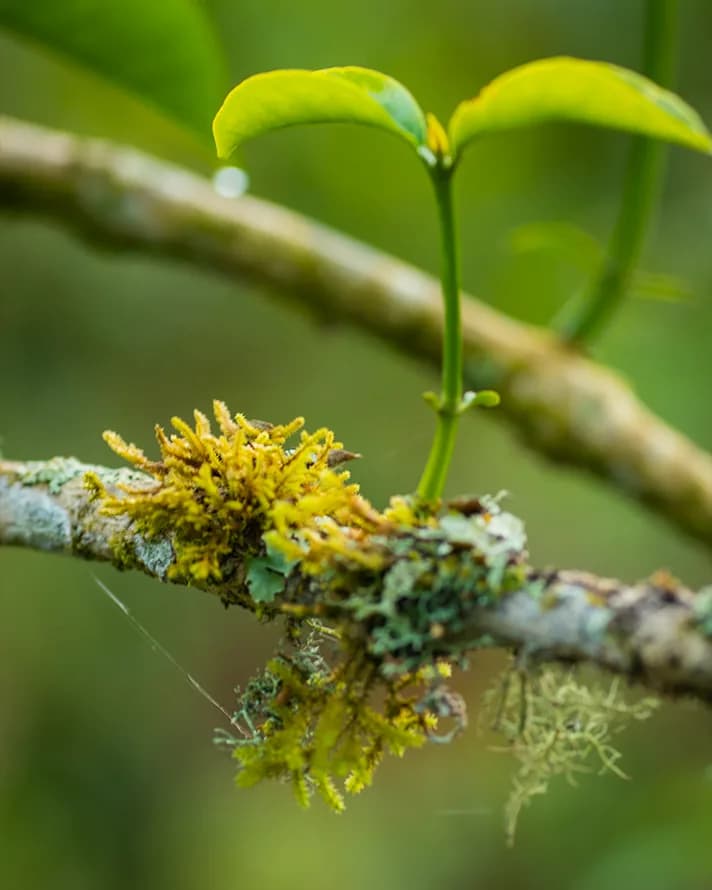
A coffee tree trunk infested with parasitic growth (yellow-green clumps of mistletoe and other epiphytes). Such parasites often blend in with moss and lichen until they begin actively growing, making early detection challenging.
One of the challenges in managing parasitic shrubs is that early infestations can be easy to overlook. However, there are tell-tale signs on coffee trees:
Visible Parasite Growth: The most obvious sign is seeing the parasite itself on the coffee plant. Mistletoe infestations appear as clusters of green leaves and stems attached to a branch of the coffee tree or its shade tree. They may look like a ball of foliage that is distinct from the coffee’s own leaves. Farmers often first notice them when the coffee tree sheds some leaves – the evergreen mistletoe clump remains, standing out against the bare branch. On the other hand, dodder looks like a tangled web of yellow, orange, or pale thread wrapped around twigs, leaves, and fruits. A coffee bush infested by dodder might have sections covered in what looks like golden string, sometimes with tiny white or yellow flowers on the vine. Locals in Uganda nicknamed one dodder “Corona” because the origin was mysterious and it seemed to overtake plants like an unknown plagueugandaradionetwork.net.
Branch and Foliage Symptoms: Parasitic plants cause physical deformities and stress symptoms in the host. A coffee branch with mistletoe often shows swelling or a knot at the attachment site as the parasite grows. Beyond that point, the branch may experience dieback – the leaves further out on that branch wilt or drop prematurely because the flow of sap has been hijackedlinkedin.com. Infected branches might also produce fewer new shoots. Similarly, a dodder-infested coffee plant will start to look stunted and yellowish in the areas under attack. Leaves that are entwined by dodder tend to discolor, and severe infestations can lead to leaf drop (defoliation) on portions of the coffee plant. You might notice the plant wilting even when soil moisture is adequate, due to the parasite pulling out water. In some cases, coffee berries on an infested branch remain small or fail to ripen properly because the nutrients are being diverted.
Reduced Flowering and Fruiting: A clear warning sign of parasitic stress is a decline in coffee flower blooms and cherry development. Heavily mistletoe-infected coffee trees often bloom sparsely, as the energy that would go into flowering is sapped awaylinkedin.com. Fewer blossoms naturally lead to fewer coffee cherries. Moreover, studies have found that dodder infestations can cause coffee cherries to be smaller and lighter than normal (reducing their quality and weight)ir-library.ku.ac.ke. In one Kenyan survey, dodder-attacked coffee trees produced berries that were about one-third lighter in weight, and many berries remained undersizedir-library.ku.ac.ke. This reduction in size and weight directly translates to yield loss at harvest.
Yield Decline and Tree Death: If parasitic infestations persist over multiple seasons, the cumulative impact on coffee yield can be devastating. Research from Ethiopian coffee farms indicates that a severe mistletoe infection can reduce coffee bean production by up to ~40% on those treeslinkedin.com. Most of this loss comes from fewer and weaker cherries, as well as the death of productive branches. Farmers have reported that badly infested coffee trees may produce almost no cherries at all after a few yearslinkedin.com. At that stage, the tree is so weakened that its chances of survival are slim – indeed, such a tree can die within 4–5 years if the parasitic growth is left uncheckedlinkedin.com. Dodder can similarly debilitate coffee shrubs; while it might not always kill the host outright, it makes the plant so weak that it succumbs to other stresses or becomes uneconomical to keep. It’s also worth noting that a parasitized coffee tree is more vulnerable to secondary problems – for example, mistletoe infections often lead to cracked bark and wounds where insects or fungal pathogens can enterlink.springer.com. This means an infested tree might suffer pest outbreaks or diseases (like wood rot) that a healthy tree could resist. All these factors contribute to long-term yield reduction.
Long-Term Consequences of Unmanaged Infestations
Allowing parasitic shrubs to run rampant in a coffee plantation has serious long-term ramifications, both for farm productivity and the surrounding ecosystem:
Gradual Spread and Hidden Reservoirs: Parasitic plants spread insidiously. Mistletoes, for instance, take several years from the initial infection to mature and produce their own seedslink.springer.com. During this time they might not be very noticeable, but once they seed, birds can carry those seeds to many other trees. New mistletoe seedlings can then crop up on coffee trees across the farm “silently,” only becoming obvious once they’ve establishedlinkedin.com. Dodder seeds can lie dormant in soil seed banks and germinate over multiple seasons. If even a few dodder vines are allowed to flower and seed, a single infestation can seed the ground with thousands of durable seeds that remain viable for years. In practice, this means one neglected parasitic growth today can turn into a widespread outbreak tomorrow.
Yield and Economic Losses Over Time: In the long term, unmanaged parasitic infestations lead to a compounding decline in coffee yields. Each year that a coffee tree supports mistletoe or dodder, it produces fewer berries and its vegetative growth is stunted. Continual nutrient theft can shorten the productive lifespan of the tree. For example, instead of remaining productive for 15–20 years, a coffee tree heavily burdened by parasites might effectively “burn out” and decline much earlier. A 40% yield loss in heavily infested treeslink.springer.com, if not addressed, can evolve into near-total crop failure on those trees in subsequent years. At the farm scale, chronic parasite problems can translate to significant income loss for farmers, threatening livelihoodslink.springer.com. The cost of replanting or rehabilitating parasite-damaged fields adds to the economic burden.
Tree Mortality and Ecological Ripple Effects: If parasitic shrubs are left to grow uncontrolled, they will continue to weaken their hosts. We often see infected branches die off first; eventually whole coffee trees can perish, especially under severe mistletoe attacklinkedin.com. As coffee trees die or must be removed, the result is thinning of the plantation’s canopy. Gaps left by dead trees can lead to erosion in hilly coffee lands and a hotter microclimate (since there are fewer leaves providing shade and cooling through transpiration). If shade trees in the plantation (like Grevillea or indigenous shade species) are also infested and killed by mistletoes, the entire agroecosystem can shift – loss of shade affects soil moisture, increases weed problems, and reduces habitat for beneficial insects and birds. In the broader environment, unchecked parasites like mistletoe can spread to native forest trees on the fringes of farms, potentially harming those ecosystems. Conversely, invasive vines like dodder pose a threat to multiple crops and wild plants, not just coffee. In Uganda, for instance, the same dodder invading coffee has also been found on tea, mango, and other vegetation in the areaugandaradionetwork.net. This cross-host spreading can alter plant community dynamics and biodiversity, as aggressive parasites may outcompete native climbers or put rare tree species at risk.
Management Difficulties Increase: The longer a parasitic infestation is ignored, the harder it becomes to control. When parasites are few, farmers can manually remove them. But if an entire farm is overtaken, eradication might require drastic measures like cutting down heavily infested shade trees or sacrificing badly infested coffee bushes. In extreme cases, land may need to be temporarily taken out of coffee production to break the parasite’s life cycle (for example, by uprooting all hosts and planting a non-susceptible cover crop for a while). These measures are costly and time-consuming. Moreover, heavy use of chemical controls might be resorted to in later stages, which can conflict with sustainability goals or certifications. Thus, the long-term consequence of inaction is often the loss of both environmental integrity and farm profitability.
Preventative Measures and Management Strategies
Coffee growers are not helpless in the face of parasitic shrubs – a combination of good agricultural practices and vigilant management can keep these pests under control. Here are practical strategies for prevention and treatment:
Early Detection and Prompt Removal: Regularly inspect coffee fields (and shade trees above the coffee) for any sign of parasitic plants. Early-stage mistletoe might look like a small tuft of leaves on a branch, and dodder initially appears as a few yellow threads on the coffee. Removing parasites early dramatically reduces damage. For mistletoe: cut off the infested branch at least 15–20 cm below the point of attachmentlink.springer.com (this ensures you remove the internal haustorium as well). It’s not enough to just pluck the mistletoe off – you need to prune the portion of the host branch it has infiltrated. For dodder: carefully unwind and pull off all dodder tendrils from the coffee plant. Because dodder can re-sprout from any piece left behind, try to remove every strand. If a coffee tree is heavily wrapped in dodder, consider pruning out the most infested sections or even removing that plant entirely if necessarylink.springer.com. Always destroy the removed parasite material – gather it in a bag and burn it or bury it. Do not leave mistletoe cuttings or dodder fragments on the ground or in a compost pile, as they may still contain seeds or viable pieces that can start new infestations.
Maintain Tree Vigor: Healthy, vigorous coffee trees are more resilient to parasite attack and can better withstand the stress if an infection occurs. Good nutrition and care won’t prevent a parasite from attaching, but it helps the tree “fight back.” Well-fertilized, well-watered coffee can often continue producing reasonably well even if a small parasite is present, whereas a weak tree would succumb quickly. In fact, severe mistletoe outbreaks are often associated with weak or neglected treeslink.springer.com. Ensure your coffee has the recommended shade, nutrients, and water for your region. Prune coffee trees properly to encourage strong new growth. A robust canopy can sometimes slow the spread of mistletoe (by shading out seedlings) and can recover from pruning wounds faster. Likewise, robust coffee can sometimes tolerate a minor dodder infestation until you remove it, without major yield loss. Think of it like keeping your trees “in good shape” so they can survive an attack.
Optimize Shade Management: Paradoxically, having some shade in the coffee farm can help with mistletoe control. Mistletoes are sun-loving parasites – even though they steal nutrients, they still need sunlight to photosynthesize and grow well. Research has observed that increased shade can significantly reduce mistletoe density and vigorlink.springer.com. Thus, maintaining a good canopy of shade trees (or interplanting bananas, etc.) can make the microclimate less friendly for mistletoe establishment. The shade slows the parasite’s growth and may reduce its seed productionlink.springer.com. Of course, you must balance this with the coffee’s need for light – it’s about optimal shade, not deep darkness. For dodder, shade is less of a factor (dodder can thrive under moderate shade), but a well-managed shade canopy still benefits the coffee’s health and can indirectly help by keeping the environment humid (dodder seeds prefer open, hot conditions to germinate). Bottom line: don’t remove too many shade trees out of fear of parasites – in fact, doing so could encourage more mistletoe growth on the remaining trees. Instead, manage shade tree pruning to ensure dappled light and monitor those trees for any parasite colonies.
Control Alternate Hosts and Weeds: Many parasitic plants can sustain themselves on alternative hosts, including common weeds or nearby cultivated plants. Dodder in particular often starts on other plants and then spreads to coffee. Keeping the farm clean of broadleaf weeds is importantir-library.ku.ac.ke – for example, if you have dense weeds or cover crops that are susceptible to dodder, the vine might establish there first and then latch onto coffee. Regular weeding can remove these “bridge” hosts. Some farmers in East Africa have even changed their hedge or border plants in response to dodder: they opt for monocotyledonous hedge plants like lemongrass, bamboo, or certain ornamentals that dodder has trouble parasitizingir-library.ku.ac.ke. This creates a sort of barrier, since dodder can’t easily use those plants to spread. In the case of mistletoe, the alternate hosts are often the shade trees or nearby forest trees. Work with neighbors or within your farm to prune out mistletoe on any tree, even if it’s not coffee, so it doesn’t serve as a seed reservoirlink.springer.com. If a particular shade tree (or fruit tree on the farm) is heavily infested with mistletoe, it may be worth removing that tree entirely and replacing it, to protect the coffee and other plants around.
Prevent Introduction of Parasites: Integrated pest management always emphasizes prevention. For dodder, preventing its introduction is key. Be cautious with any new planting material: ensure coffee seedlings or any nursery stock you bring in are not tangled with dodder vines or contaminated with dodder seed. Dodder seeds are small and can hide in soil clods or hitchhike in hay, mulch, or manure. If you bring in mulch or organic matter from outside, know the source – material from infested areas could carry seeds. Also, clean farm equipment and tools if they’ve been used in an infested field. Something as simple as a machete or pruning shear could potentially lodge a dodder seed and move it to a new location. Since dodder seeds often spread through contaminated crop seedslink.springer.com, if you intercrop or rotate coffee with other plants, make sure those seeds are cleaned (especially if it’s a crop known to have dodder issues). For mistletoe, introduction is usually via birds – which is hard to prevent – but you can discourage birds from perching and roosting in certain trees by using bird scarers or pruning high perching branches. Some farmers put reflective tape or streamers in heavily infested spots to reduce bird activity until they can eliminate the parasite.
Community Cooperation: Parasitic weed control can benefit greatly from a community approach. If your farm is clean but a neighbor’s farm is full of mistletoe, birds can easily reintroduce it to your trees. Likewise, dodder vines don’t respect property lines – they can spread along water ditches or roadways. It pays to share knowledge with fellow farmers and coordinate control efforts. For instance, a group of farmers in one village might organize an annual “mistletoe cleanup” day to collectively prune out infestations in the area. By ensuring that no single farm becomes a host reservoir, everyone’s coffee is safer. Extension services or coffee cooperatives can help in spreading awareness about identifying these parasites. Training farm workers is also crucial (see the next point).
Train Workers to Identify and Act: Many coffee farms rely on hired labor or family members to do routine work like pruning and weeding. It is important that everyone involved can recognize parasitic plants early. A worker who notices a strange vine on a coffee bush should not just weed-whack it and leave it – they should remove it carefully and inform the farm manager. Consider holding a short training or demonstration: show what mistletoe berries and seedlings look like on branches, show what dodder looks like when it starts growing, and explain the removal procedure. Encourage workers to report any suspicious plant growth. It’s far better to have several pairs of eyes looking for the “silent invaders” than to leave it to chance.
Chemical and Biological Controls (Use with Caution): Currently, there are no easy chemical fixes for parasitic shrubs on coffee that wouldn’t also harm the coffee tree. However, in some cases arborists have used targeted chemicals – for example, injecting a herbicide into an infested shade tree’s trunk to kill mistletoe internallylink.springer.com. This method is labor-intensive and usually reserved for high-value trees (it may not be practical for large farm settings). Foliar spraying of herbicides is tricky: a general herbicide will kill the parasite and the coffee leaves it’s attached to. Some studies and farmer experiments have shown that spot-applying systemic herbicide (like a dilute glyphosate solution) directly onto dodder vines can kill the dodderir-library.ku.ac.ke. This must be done very carefully to avoid getting the chemical on the coffee plant. Similarly, applying an herbicidal paste on a cut mistletoe stump might stop it from resprouting. Any chemical approach should be tested on a small scale first, or done with guidance from agricultural experts, to avoid unintended damage. On the biological front, researchers are exploring natural enemies (for example, certain fungi or insects that attack mistletoes or dodder). These biological controls are still mostly in experimental stages and not widely available, but future integrated pest management may include them. For now, manual removal and cultural practices are the primary and safest means to manage parasitic shrubs in coffee.
Dispose of Parasites Safely: It’s worth re-emphasizing the importance of disposal because throwing an infested branch on the ground can undo all your hard work. Mistletoe berries can ripen and spread even on cut branches, and dodder segments can sometimes survive short periods off-host. So, burn pruned mistletoe material if you can, or cart it far away from coffee production areas. For dodder, burning is best; if you can’t burn, bag it and dispose of it in a landfill rather than composting. Some farmers will solarize dodder debris by sealing it in a black plastic bag and leaving it in the sun to “cook” for several days, killing seeds
By following these strategies, coffee growers can significantly mitigate the threat of parasitic shrubs. The key is to be proactive and consistent – once you’ve cleaned up an infestation, remain vigilant in the following seasons to catch any stragglers or new invasions early. Parasitic plants may be silent and slow at first, but they are persistent foes. Through regular farm hygiene, community awareness, and prompt action, farmers can protect their coffee trees from these nutrient thieves. Not only does this safeguard yields and income, but it also helps maintain the overall health of the coffee agroecosystem – ensuring that coffee plants, shade trees, and surrounding vegetation can thrive in balance, without unwelcome parasites tipping the scales.
In summary, while parasitic shrubs like mistletoes and dodder may not grab headlines as quickly as insects or fungal diseases, they represent a steady, creeping threat to coffee productivity and sustainability. Recognizing the problem is the first step. With the knowledge of how these parasites operate and how to control them, farmers have the tools to combat the “silent threat” and keep their coffee crops robust. By staying alert and responding decisively, we can prevent a minor parasitic plant sighting from turning into a major headache – protecting our coffee trees for future seasons and generations.
Comments (0)
No comments yet. Be the first to share your thoughts.


Comments (0)
No comments yet. Be the first to share your thoughts.